UNDP's commitment to addressing HIV and other major health and development challenges is based on the principles that health is a driver for and an indicator and outcome of development.
As outlined in the UNDP Strategic Plan 2022-2025, UNDP’s support to countries aims to eradicate poverty in all its forms and dimensions, accelerating structural transformation for sustainable development and supporting governments to build resilience to shocks and crises.
UNDP defines capacity development as the process through which individuals, organizations and societies obtain, strengthen and maintain the capabilities to set and achieve their own development objectives over time.
Strong partnerships are the cornerstone of UNDP's work to strengthen systems for health. In its support to countries UNDP works closely with other United Nations entities, development organizations, civil society organizations, the private sector, academia and key populations to develop resilient and sustainable systems for health.
The effectiveness of UNDP's model of health programme support, with its emphasis on end-to-end capacity development, is evident in the results of its long-standing partnership with the Global Fund to Fight AIDS, Tuberculosis and Malaria (the Global Fund).
Whether in its role as an implementing partner managing large-scale HIV, TB, and malaria programmes funded by the Global Fund or as a technical assistance
Investments in resilient and sustainable systems for health lay the foundation for the effective and equitable delivery of HIV, tuberculosis (TB) and malaria.
Human rights barriers include stigma and discrimination, punitive laws, policies and practices, violence, harassment, gender, and social and economic inequalities.
People most affected by HIV, tuberculosis (TB) and malaria are often the same people who are marginalised and have limited or no access to health care.
Gender equality is essential to achieving health and well-being for all, accelerate progress towards the health-related Sustainable Development Goal (SDG) targets and ensuring that no one is left behind.
Successful and sustainable capacity development can only occur when there is commitment from individuals who invest in the process from the design stage onwards. Engaging stakeholders to build consensus from the time of designing the capacity development process is vital to ensure that all country partners are kept informed, consulted and engaged as necessary. Each organization will have a different role and view of the capacity development effort. UNDP works with organizations to bring country stakeholders together, along with tools to outline the scope and process for the capacity development.
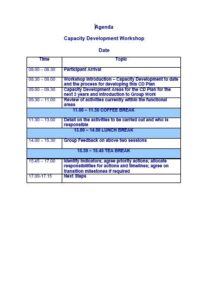
UNDP facilitates review workshops, bringing together all relevant groups, and provides template agendas to help guide the discussions. It supports the stakeholders in particular through the following actions:
Assessment verification: the assessment results and the proposed activities should be verified with appropriate stakeholders and partners.
Prioritize and schedule interventions and finalize the budget: it is important at this stage to prioritize capacity development objectives and activities, given that the available resources may not cover the full plan and that certain activities may be more crucial than others to the achievement of national strategic goals. Following the verification and the prioritization, the budget may need to be revised. Funds for capacity development management activities should be included in the overall budget. This should cover all coordination/management costs, monitoring and evaluation processes, and costs associated with the capacity development of staff.
Draft the capacity development plan report: it may be helpful at this stage to document the elements of the plan, to share with in-country partners and other donors.
Sign-off from national leaders: capacity development is nationally owned and the final approval for the plan should lie with the organization(s) being strengthened. The final approval to proceed should be obtained by the senior management of the organization(s) involved.
Launch the plan: it may be useful to hold a launch of the plan to ensure all relevant stakeholders are aware of the final focus and activities. This also contributes to the buy-in and coordination of the plan. If funds are still required (both financial and human resources) this may be an opportunity to approach donors.
Tools and guidance
Example templates for stakeholder review workshops and capacity development plan budgets are available in the key resources section below.
The following points should be considered when carrying out the stakeholder review and finalizing the capacity development plan.
A plan is only of use if it is implemented. An important consideration of the stakeholder review is to ensure ongoing ownership and responsibility, to move the plan from the assessment and planning stage to the implementation stage. Implementation will only take place if a majority of stakeholders feel ownership towards the plan’s activities and objectives.
Supporters and resisters should be considered. In defining a plan of change for any organization, there will be supporters and adversaries; the objective should be to engage both parties in a joint effort to agree on prioritized activities.
Realistic schedules and timelines should be defined. Consideration should be given to the time required to review by all country stakeholders. In addition, obtaining funding for the plan may also take time. This can delay implementation by six months to a year after the completion of a capacity development plan.
Donors may be able to offer in-kind resources as well as financial ones. Some donors may be able to offer in-kind support instead of money; this could include providing consultants or technical experts to carry out training or mentoring, or computer hardware or software packages to improve systems.
Cross-organizational activities can help reduce costs. If multiple organizations are included within the plan, consider identifying cross-organizational activities. Often a capacity need is required by several different implementers. Sharing activities across organizations may help to reduce overall costs; for example, only one set of training tools will be required for multiple training sessions.