UNDP's commitment to addressing HIV and other major health and development challenges is based on the principles that health is a driver for and an indicator and outcome of development.
As outlined in the UNDP Strategic Plan 2022-2025, UNDP’s support to countries aims to eradicate poverty in all its forms and dimensions, accelerating structural transformation for sustainable development and supporting governments to build resilience to shocks and crises.
UNDP defines capacity development as the process through which individuals, organizations and societies obtain, strengthen and maintain the capabilities to set and achieve their own development objectives over time.
Strong partnerships are the cornerstone of UNDP's work to strengthen systems for health. In its support to countries UNDP works closely with other United Nations entities, development organizations, civil society organizations, the private sector, academia and key populations to develop resilient and sustainable systems for health.
The effectiveness of UNDP's model of health programme support, with its emphasis on end-to-end capacity development, is evident in the results of its long-standing partnership with the Global Fund to Fight AIDS, Tuberculosis and Malaria (the Global Fund).
Whether in its role as an implementing partner managing large-scale HIV, TB, and malaria programmes funded by the Global Fund or as a technical assistance
Investments in resilient and sustainable systems for health lay the foundation for the effective and equitable delivery of HIV, tuberculosis (TB) and malaria.
Human rights barriers include stigma and discrimination, punitive laws, policies and practices, violence, harassment, gender, and social and economic inequalities.
People most affected by HIV, tuberculosis (TB) and malaria are often the same people who are marginalised and have limited or no access to health care.
Gender equality is essential to achieving health and well-being for all, accelerate progress towards the health-related Sustainable Development Goal (SDG) targets and ensuring that no one is left behind.
Challenges that have hindered the effectiveness of anti-corruption efforts in past decades have included the following:
Good governance and public sector reforms are too broad and avoid tackling corruption directly.
Anti-corruption interventions in health programmes are often disconnected from national health systems and the country context.
Anti-corruption communities are disconnected from public health communities, with no common language between them.
Anti-corruption communities focus mainly on punitive approaches and post-event detection, and preventive approaches are focused on awareness and implementing excessive controls.
Sectorial and preventive strategies to fight corruption need to be further strengthened to enhance the overall effectiveness of anti-corruption. A well-established approach to engage in prevention in a specific context is to conduct risk assessments, as addressing risks is one of the key components of prevention. In the field of anti-corruption, risk assessment can broadly be defined as the analysis and study of the likelihood and impact of specific corrupt acts for the purpose of mitigating them. It distinguishes itself from other corruption assessment approaches in that it focuses on the potential for – rather than the perception, existence or extent of – corruption.
UNDP’s approach
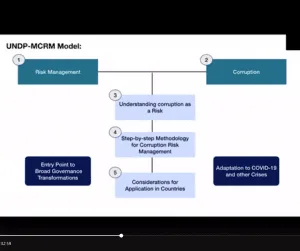
Based on gaps in traditional anti-corruption approaches and building on its longstanding engagement with governments, civil society organizations and other partners on corruption prevention initiatives over the years, UNDP developed a comprehensive risk-based methodology to help advance countries’ corruption prevention efforts: the UNDP methodology for corruption risk management. Starting in 2016, it first piloted the approach in six countries and territories in the Middle East and North Africa. It continues to share lessons, develop tools and guidance, and train countries to implement risk-based approaches to corruption in other regions, in partnership with the Global Fund to Fight AIDS, Tuberculosis and Malaria (Global Fund), the World Health Organization (WHO) and the World Bank.
The framework uses a corruption risk assessment to help countries identify vulnerable “decision points” in the health system, or other sectors, based on the likelihood and impact of corruption at each point. The assessment is conducted through national multi-stakeholder teams. Following training on the methodology, country stakeholders are able to map decision points and identify respective stakeholders and action points through a function-based approach combined with process mapping. The resulting risk heat maps allow for prioritization of corruption risk mitigation measures and the development of a sectoral implementation plan.
The experiences implementing this approach to date have underscored that:
The integrated corruption risk methodology helps to align and coordinate efforts of donor agencies and different health system functions to address corruption along the entire continuum of health service delivery, which is a key factor for sustainability.
Preventive approaches minimize the sensitivity of countries to the topic, as it addresses risks of potential acts rather than focusing on punitive measures.
Application through multi-stakeholder teams creates country ownership, ensures response to national priorities and improves access to information without jeopardizing confidentiality and sovereignty. It also builds national capacities and offers a platform for continuity of the process.
A flexible two-pronged approach that entails direct interventions for immediate response combined with long-term strategic engagement on corruption helps country teams to respond to pressing needs while not losing strategic focus.
Additional benefits include the creation of a common language among stakeholders between and within sectors, the integration of health system strengthening efforts with specific programme needs and the promotion of country ownership.
Guidance and resources
This section provides a high-level overview of key steps in the process of applying UNDP’s corruption risk management approach, which can be adapted to different contexts and objectives. Full details on the activities, tools and concepts entailed in each step can be found in a forthcoming guide. A case study on the experience and lessons from Tunisia, the first country to roll out this approach and achieve results in the health sector in particular, can be found here. Additional guidance can be found in the webinar recordings in the key resources below. If you are a government partner or another stakeholder engaged in implementing a UNDP-supported health programme and would like to initiate this process in your country, please contact support.healthimplementation@undp.org for further information and guidance.
Step 1: scope and context
The scope can be developed through surveys, consultations, desk research, analyzing historical data and review of previous reports, national policies and/or prior corruption cases. During the scoping exercise, the context needs to be thoroughly understood and the criteria for risk evaluation have to be defined. The final stage of scoping is to identify the ‘decision/action points’ and generate a list, followed by defining the potential deviated decisions associated with each of them. To identify decision points, process mapping is used to follow the steps, decisions and actions in a routine workflow illustrated in a visual form. It can be used to simplify a process and facilitate breaking it down to reach the units of analysis that are decision/action points.
Step 2: risk assessment
A prospective analysis is conducted to identify all potential corrupt acts and deviations that might take place around each decision/action point. A risk analysis is then conducted to assess the impact (significance) and likelihood (probability) of the corruption risks identified. After having determined ‘impact’ and ‘likelihood’, respective outcomes can be used to define the risk level (profile) of the decisions/action point. Decision/action points are assessed one by one to categorize each as low, medium, high or critical risk. The risk evaluation is based on pre-set criteria agreed during the scoping phase. Based on this assessment, the decision/action points are illustrated on a ‘risk heat map’ according to their risk profiles. The visual representation helps to facilitate further evaluation, prioritization and monitoring.
Step 3: exploring risk treatment options
After the plotting of the different points on the heat map and the evaluation of the risks, the next step is to explore the different treatment options for the selected corruption risks. The trade-offs between the potential negative impact of a corruption risk and any potential damage that might happen because of the measures designed to control the risk should be carefully weighed. It is advisable to focus on controls that can mitigate risks of corruption while advancing performance and the achievement of health outcomes, minimizing waste and mitigating other governance related risks such as negligence and theft. Likewise, it is good to prioritize controls that can mitigate several corruption risks at several decision points, such as a software that can improve control over the whole supply chain.
Step 4: prioritization
Given resource limitations, a systematic prioritization process for risk treatment measures should be established based on evidence and preset criteria. The prioritization process should enable stakeholders to reach consensus on what decision/action points are the most important (politically, socially and/or economically), what response is the most feasible and what interventions will have the strongest positive impact. This paves the way for an actionable plan that is applicable within the country context and with the available resources.
Step 5: planning and implementation
Based on the results of the prioritization, a plan should be put in place to tackle the selected corruption risks and resources should be allocated and mobilized to implement the plan. This should be followed by implementation of interventions to address the risks. Certain baseline assessments need to be carried out as well.
Ongoing activities during implementation
Communication and consultation: An important factor for the success of risk management is that relevant stakeholders are updated about the risks, treatment plans and any changes in risk levels, interventions or emergent risks through clear communication. Consultation is another important activity, as this gives stakeholders the opportunity to give their inputs and, stay engaged and it creates constructive feedback loops.
Monitoring and review: The key indicator in risk monitoring is the change of risk level of a decision/action point. In addition to monitoring the risk, it is important to monitor some performance indicators for risk treatment interventions. This could be generated through determining the impact of the intervention for example on financial performance, health outcomes and other outcomes. Other sets of indicators can address issues regarding change of behavior, awareness levels and capacities developed. It is advisable to use qualitative methods to allow the collective assessment of risk. Corruption risks might be difficult to quantify and it might be useful to use a mixture of qualitative methods to ensure credible assessments.
Recording and reporting: The recording and reporting should start from the process of scope and context and should continue all through the risk management cycle. Recording and reporting set the basis for communication and consultation for risk management
Webinar recording (Video) UNDP conducted two webinars in November and December 2020 – an introductory session and a more comprehensive training session – on the corruption on the methodology for...