UNDP's commitment to addressing HIV and other major health and development challenges is based on the principles that health is a driver for and an indicator and outcome of development.
As outlined in the UNDP Strategic Plan 2022-2025, UNDP’s support to countries aims to eradicate poverty in all its forms and dimensions, accelerating structural transformation for sustainable development and supporting governments to build resilience to shocks and crises.
UNDP defines capacity development as the process through which individuals, organizations and societies obtain, strengthen and maintain the capabilities to set and achieve their own development objectives over time.
Strong partnerships are the cornerstone of UNDP's work to strengthen systems for health. In its support to countries UNDP works closely with other United Nations entities, development organizations, civil society organizations, the private sector, academia and key populations to develop resilient and sustainable systems for health.
The effectiveness of UNDP's model of health programme support, with its emphasis on end-to-end capacity development, is evident in the results of its long-standing partnership with the Global Fund to Fight AIDS, Tuberculosis and Malaria (the Global Fund).
Whether in its role as an implementing partner managing large-scale HIV, TB, and malaria programmes funded by the Global Fund or as a technical assistance
Investments in resilient and sustainable systems for health lay the foundation for the effective and equitable delivery of HIV, tuberculosis (TB) and malaria.
Human rights barriers include stigma and discrimination, punitive laws, policies and practices, violence, harassment, gender, and social and economic inequalities.
People most affected by HIV, tuberculosis (TB) and malaria are often the same people who are marginalised and have limited or no access to health care.
Gender equality is essential to achieving health and well-being for all, accelerate progress towards the health-related Sustainable Development Goal (SDG) targets and ensuring that no one is left behind.
The role of a health information system (HIS) is to enable the use of reliable and timely data by decision makers at all levels of the health system. The HIS is therefore reliant on, and is only as good as, the quality of data collected. High-quality and up-to-date data are necessary for countries to respond quickly to public health crises and ensure the effectiveness of ongoing health service delivery. This includes making information available on vulnerable groups and key populations most affected by health issues, to ensure that services can be effectively tailored to the needs and unique barriers to health access faced by those communities. The strength of the HIS also ensures that when an emergency health situation arises, decision makers are aware of it early and can divert the necessary resources to prevent epidemics.
In many countries, the quality of data gathered at health facilities and the capacity to analyse and use these data remain inadequate to support decision-making that will accelerate the achievement of universal health coverage. Most countries have health facility registries and service-use reporting forms; they maintain medical record rooms and may have health information units overflowing with data. Despite this abundance of data, many still find it challenging to collect high-quality data in a timely manner, produce disaggregated data and use them for policy and planning.
Among the challenges is the fact that data may be incomplete or of poor quality or that there may be duplication and fragmentation of data across reporting systems developed by different users. This makes it difficult to connect the resources invested to the results achieved. Data needs and demands are also changing with the rise in non-communicable diseases. More technical skills in key areas such as epidemiology, biostatistics and database management are needed, as well as skills to analyse statistics across different programmes and sectors. Responsibility for data entry, verification, validation and management is distributed across various individuals, professions, units, departments and facilities at the different levels of the HIS. Programmatic or patient care data are often collected and managed separately from health products or stock data. Staff rotation is another concern in relation to maintaining appropriate standards, as such a situation affects data quality. In addition, data quality is rarely seen as a priority and the resources available are limited.
UNDP’s approach
As Principal Recipient of the Global Fund grants, UNDP is highly committed to improving health data quality, analysis and use to support decision-making within health programmes and systems. UNDP provides capacity development and good practice support during data collection and data management processes. More specifically, UNDP supports ministries of health and other partners at various levels of health information chains in their processes to:
assess regularly the quality of project data through internal routine tools and external processes
formulate and implement a health data quality development plan
facilitate high data quality standards at all levels of the health information system
develop tools and methods for data collection and use
strengthen the capacity of health information system professionals in data collection, management and analysis
strengthen the data flow at all levels of the health pyramid.
Tools and guidance
Further information on core data components that constitute a health information system (HIS), to inform the entry points for capacity development, can be found in this UNDP guidance note.
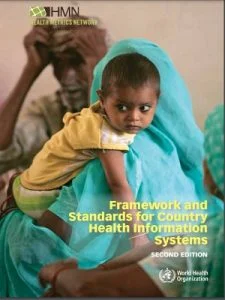
UNDP’s technical assistance to strengthen data collection and use for better health outcomes considers the capacities required across the interconnected components of national HISs. This includes the following six components of HISs defined by the World Health Organization (WHO), as detailed in the Framework and Standards for Country Health Information Systems (2012):
Health information system resources. These consist of the legislative, regulatory and planning frameworks required to ensure a fully functioning HIS and the resources that are required for such a system to be functional, such as personnel, financing, and information and communications technology (ICT).
Indicators. A core set of indicators and related targets are the basis for an HIS plan and strategy. Indicators need to encompass determinants of health, health system inputs, outputs, outcomes and health status.
Data sources. These should include population-based approaches (censuses, surveys and civil registration), institution-based data (individual records, service records and resource records) and additional information from occasional health surveys, research and information produced by community-based organizations.
Data management. This includes the collection, storage, quality assurance, flow, processing, compilation and analysis of data.
Information products. Data must be transformed into information that will become the basis for evidence and decision-making.
Dissemination and use. The value of health information can be enhanced by making it readily accessible to decision makers.
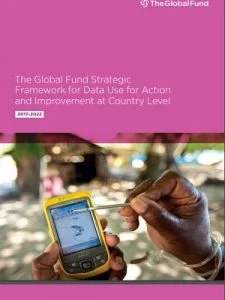
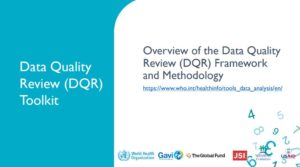
Additional resources from WHO, the Global Fund to Fight AIDS, Tuberculosis and Malaria (The Global Fund) and other global health partners can be found under key resources below. They include tools to inform the selection of data collection indicators, facilitate data quality reviews and strengthen processes and capacities for data analysis and use to achieve national health priorities.
Indicator guidance for Global Fund programmes
For countries implementing HIV, tuberculosis, malaria and health systems strengthening programmes funded by the Global Fund to Fight AIDS, Tuberculosis and Malaria (The Global Fund), the Global Fund asks implementers to select their programme indicators from a core list of indicators. These indicators aim to promote a common understanding of monitoring and evaluation and to reduce the reporting burden for countries. The Global Fund Modular Framework Handbook 2023 – 2025 provides guidance on selecting indicators relevant to agreed programme activities to measure progress on health interventions. For more detailed information on the HIV, tuberculosis, malaria and resilient and sustainable systems for health (RSSH) indicators, please review the indicator guidance sheets (August 2020):
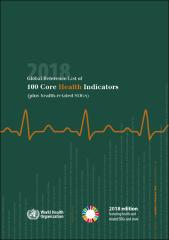
This resource is intended to be the universally accepted standard for guiding the collection, reporting and use of health information by all developing countries and global agencies.
The tool helps to enhance entire health information and statistical systems, and to concentrate efforts on strengthening country leadership for health information production and use.