Quality assurance of health products
Purpose
The quality of health products has to be ensured from manufacturing up to the point of use. Quality assurance (QA) is an overarching element to the whole PSM cycle, beyond the prequalification of health products, to ensure compliance with WHO and national standards. Transportation, storage, distribution and use conditions impact the quality of health products.
Key concepts
Quality assurance
“Quality assurance is a wide-ranging concept covering all matters that individually or collectively influence the quality of a product. It is the totality of the arrangements made with the object of ensuring that pharmaceutical products are of the quality required for their intended use.” – World Health Organization
Prequalification
“The activities undertaken in defining a product or service need, seeking expressions of interest from enterprises to supply the product or service, and examining the product or service offered against the specification and the facility where the product or service is prepared against common standards of good manufacturing practice (GMP). Prequalification is required for all pharmaceutical products regardless of their composition and place of manufacture/registration.” – World Health Organization
Quality control
“Quality control covers all measures taken, including the setting of specifications, sampling, testing and analytical clearance, to ensure that starting materials, intermediates, packaging materials and finished pharmaceutical products conform with established specifications for identity, strength, purity and other characteristics.” – World Health Organization
Pharmaceutical waste management
Pharmaceutical waste management is regarded to be an integral part of quality assurance within supply chain management and the product lifecycle, as a result of the use and/or expiry of health products. Inadequate and inappropriate handling of healthcare waste can have serious public and global health consequences and a significant impact on the environment. Refer to the Health care waste management page for further information.
UNDP’s approach
Upon governments’ requests, UNDP can provide support for identifying and assessing health products in accordance with World Health Organization (WHO) and international standards. It can also mobilize a pool of international experts to assist the regulatory authorities in the identification, assessment and prequalification of health products, in accordance with WHO and international standards. The same experts can be mobilized to provide training sessions in quality assurance to counterparts (regulatory authorities or central medical stores) in countries based on specific requests submitted by the authorities.
Tools and guidance
The health procurement performed by UNDP for donor grants complies with quality assurance policies established by the donor for specific health product categories. For other health product categories and for government-funded health procurement, UNDP has defined its own quality assurance policy for health products for medicines, medical devices including diagnostic products and personal protective equipment (PPE). The UNDP QA policy is based on WHO norms and standards and is aligned with the policies of other key stakeholders (the Global Fund to Fight AIDS, Tuberculosis and Malaria, the United Nations Children’s Fund – UNICEF, the United Nations Population Fund – UNFPA, Doctors Without Borders – MSF, International Committee of the Red Cross – ICRC, etc.).
UNDP support to quality assurance: country examples
Zimbabwe obtained prequalification status from the World Health Organization (WHO) for its chemical laboratory to perform quality control (QC) in 2014 and it is in the process of getting its microbiology laboratory WHO-prequalified. UNDP is also supporting Sudan and Afghanistan to upgrade their QC laboratories to meet the WHO prequalification status.
Key Resources

WHO Prequalification Programme for Medicines, WHO Prequalification Programme for In-Vitro Diagnostics, WHO Prequalification of Vaccines, WHO Prequalification of Vector Control Products, WHO/UNFPA Prequalification Programme for Male Latex Condoms, WHO/UNFPA Prequalification...
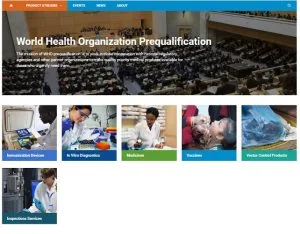
World Health OrganizationA quality control laboratory prequalification has been established by WHO to enhance in-country capacities for the quality control of medicines.
WHO has also established general requirements for quality assurance systems for procurement agencies to ensure that transactions with partners ultimately result in procuring health products of the best possible quality:
Relevant sections include:Annex 9: Guidelines on the implementation of the WHO certification scheme on the quality of pharmaceutical products moving in international commerceAnnex 10: Good reliance practices in the regulation...
United Nations Development Programme
Countries can benefit from WHO guidance and tools for strengthening national regulatory authority functions, as well as for enabling and speeding up registration of WHO-prequalified and stringent national regulatory authority-registered...
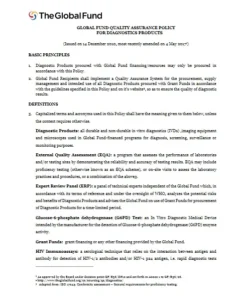
The Global FundGlobal Fund principles and standards related to quality assurance of health products are summarized in this booklet

United Nations Development Programme