Interventions for community systems strengthening
Purpose
Community system strengthening is about strengthening systems. It is about investing in the system pillars that enable community organizations and key population networks and groups to maximize their contribution to all aspects of health programming. Strengthening community systems also means investing in an environment that is enabling for communities and community organizations and ensuring that there is a place at the table for civil society organizations to be consulted on health-related decisions at every step.
Intervention areas
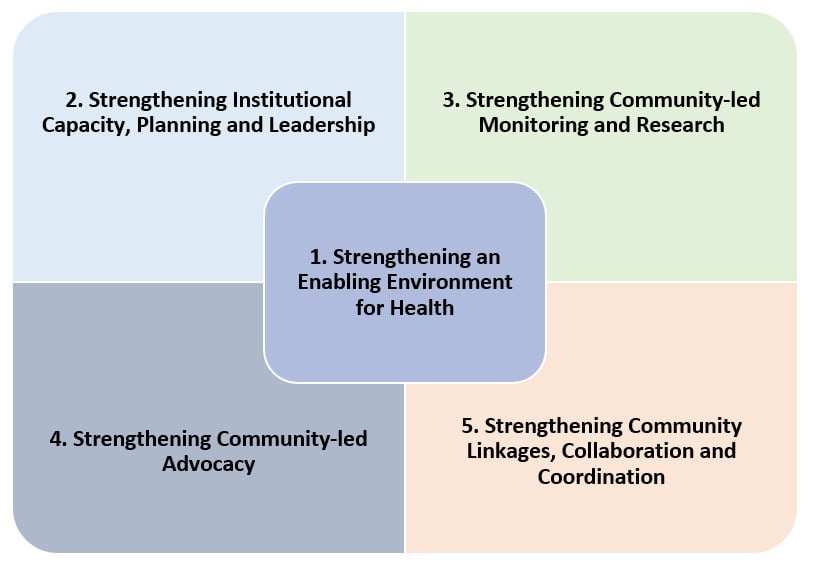
There are five main interventions that UNDP deploys for community systems strengthening: 1) strengthening an enabling environment for health; 2) strengthening institutional capacity, planning and leadership; 3) strengthening community-led monitoring and research; 4) strengthening community-led advocacy; and 5) strengthening community linkages, collaboration and coordination.
Building an enabling environment for community systems
This intervention involves work with other stakeholders to create and reinforce a legal, policy, regulatory and strategy environment that is conducive and responsive to health for all sectors of the community and that reinforces the work of community-led organizations. It is important to involve community-led and key population organizations in the design, implementation and monitoring of activities in this intervention.
It includes:
- Providing financial and/or technical support for capacity strengthening of key duty bearers such as parliamentarians, national human rights institutions, health service providers, policymakers, law enforcement officials, lawyers and the judiciary to create an awareness of the importance of community systems and of the barriers to health and access to services that particular communities or groups face. Duty bearers need to be able to understand and address legal, policy, regulatory and strategy barriers to access to health services and have the capacity to avert and respond to human rights violations.
- Providing financial and/or technical support for capacity strengthening of key duty bearers to understand the important role played by policy dialogue and community-led advocacy in access to health, to ensure the provision of necessary space for community-led advocacy and to protect the safety of activists.
Strengthening institutional capacity, planning and leadership
This intervention involves strengthening the capacity of individuals, community groups, organizations and networks in a range of areas necessary for them to fulfil their roles in service provision, social mobilization, monitoring and advocacy.
It includes:
- Providing financial and/or technical support and mentoring for planning, financial management, institutional and organizational development, systems development, human resources and leadership development, transparency, equity and community sector organizing.
- Providing financial and/or technical support (including training and tools) to the community sector as required to enable them to fulfil roles in service provision, social mobilization, monitoring and advocacy. Community members should not be asked to work without proper remuneration. It is necessary to find or provide support for both core funding for community-based organizations and networks, including organizational overheads and staff salaries and stipends, and targeted funding for implementing programmes and interventions.
Strengthening community-led monitoring and research
This intervention involves strengthening the capacity of community-based organizations and other community groups to monitor, document and analyse the performance of health services as a basis for accountability, advocacy and policy activities. Key population groups often have their own long-established ways of collecting and acting on information. Community-based monitoring simply formalises and builds on these systems, linking them to services provided by the government and non-governmental organizations. Refer to the Health Information Systems section for more information.
It includes:
- Providing financial and/or technical support (including training and tools) to establish and implement community-led mechanisms for ongoing monitoring of health policies and strategies, of performance against targets and of the quality of health services and related activities.
- Providing financial and/or technical support for community-led monitoring and tracking of other factors that are part of an enabling environment for health and well-being, such as financing of programmes, discrimination, gender-based inequalities and other social, economic and environmental determinants of health. Again, this is dependent on having good national and subnational information.
Strengthening community-led advocacy
This intervention involves strengthening the capacity of community-led organizations and key population groups to hold service providers, national programmes, policy-makers, and local and national leaders accountable for the effective delivery of services and other health-related activities.
It includes:
- Providing financial and/or technical support (including training and tools) and mentoring for community-led organizations and key population groups to design and conduct advocacy activities at local and national levels aimed at holding to account those responsible for health policy and service provision, including disease-specific programmes. Advocacy activities aimed at broader issues that affect health and access to services are also important, such as activities that highlight discrimination, gender inequality, sustainable financing and the protection and promotion of human rights.
Strengthening community linkages, collaboration and coordination
This intervention involves strengthening the capacity of community organizations and networks to work within a community systems framework.
It includes:
- Providing financial and/or technical support and mentoring to develop platforms and mechanisms for networking and for developing effective linkages within and between community groups and networks working on different aspects of improving health and well-being. Mechanisms for coordinating and collaborating with broader movements should also be developed, to mainstream health issues in, for example, human rights, environmental and women’s movements.
Key Resources