Digital technologies for real-time health data and decision-making
UNDP’s approach
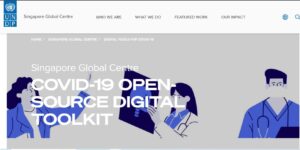
Among the applications of digital technologies that UNDP promotes in the health sector are those aimed at strengthening real-time capture, monitoring, and use of data within national HIV, malaria, tuberculosis and other health programmes. This support ranges from the digitalization of national health information systems, such as through the roll-out of the electronic district health information system (DHIS-2), and the use of mobile technologies within disease surveillance and tracking systems. UNDP likewise helps countries to identify and adapt open-source digital tools suitable for resource constrained contexts, including those to support disease monitoring, prevention, diagnosis, and recovery efforts in COVID-19 and beyond. This page provides some examples of digital health technologies that have supported countries to leverage data to enhance the coverage and quality of disease prevention and treatment efforts. Visit the Health information systems section for more information on UNDP’s broader capacity development support to strengthen health management information systems.
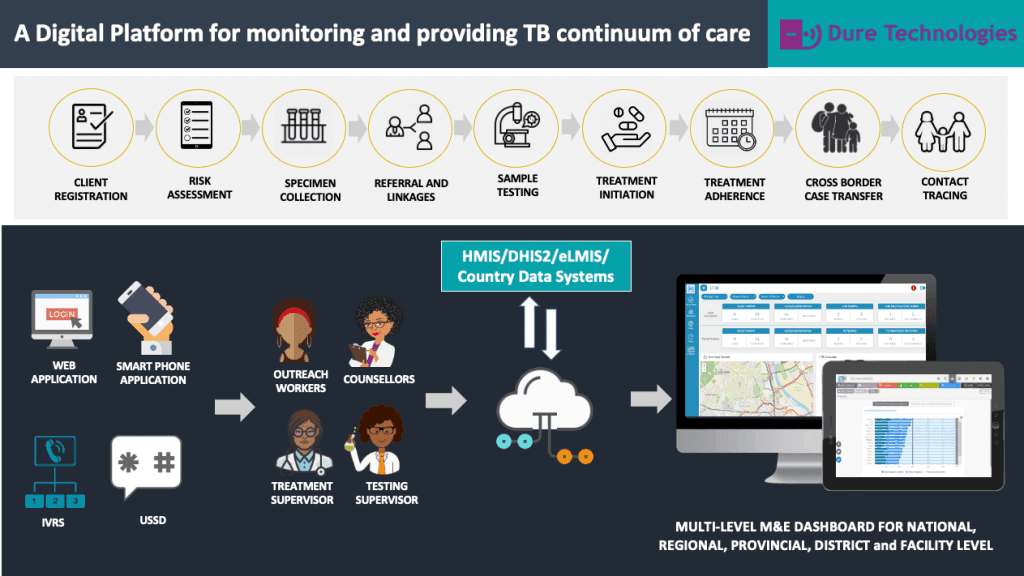
Cross-border platform to prevent tuberculosis
As part of the UNDP-managed Global Fund to fight AIDS, Tuberculosis and Malaria (Global Fund) multi-country tuberculosis grant for migrants, refugees and returnees in Afghanistan, Iran, and Pakistan, UNDP is working with Dure Technologies on a digital application (app) and dashboard to monitor and provide tuberculosis continuum of care. The app captures data on client registration, risk assessment, specimen collection, referral and linkages, sample testing, treatment initiation, treatment adherence, cross border case transfer, and contact tracing. It is able to support cross-border tracking of lost follow up cases through a quick response (QR) code.
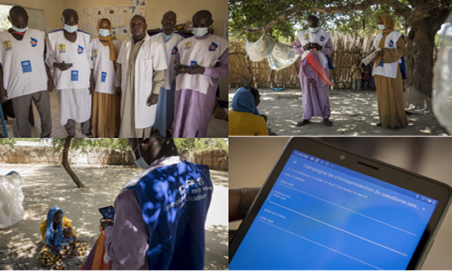
Real-time monitoring of the malaria response in Guinea Bissau
In Guinea Bissau, where malaria is the leading cause of illness, the health information management system is weak and consequently, the data reported not only are of low quality but also arrives late at point of analysis and decision making at the regional and central levels. With financial support from the Global Fund to Fight AIDS, Tuberculosis and Malaria (Global Fund) and the World Bank, UNDP supported the government to introduce real-time monitoring using mobile tablets to digitize malaria data, track malaria outbreaks, and digitally map available medicines and bed-nets. Technological considerations in developing the technology focused on ensuring its linkage to the national health management information system database, the electronic district health information system DHIS2. UNDP received support from the University of Oslo to develop the application as an extension of DHIS2 and configure the tablets with DHIS2 capture, which captures aggregated routine health data, and a DHIS2 tracker, for individual-level patient data. The tool focuses on data related to case management and prevention, mosquito net distribution, availability of malaria medicines, and weekly surveillance for World Health Organization (WHO) notifiable diseases.
Digital solutions for malaria prevention in Chad
UNDP supports Chad’s National Malaria Control Programme (NMCP) with malaria prevention for millions of people through a Global Fund grant. Key approaches include the routine and mass distribution of long-lasting insecticide-treated bed nets (LLINs) and seasonal malaria chemoprevention (SMC), a series of preventive medicines given to children under five years during the rainy season, when malaria transmission is highest.
During the 2022 SMC campaign, UNDP and NMCP digitized data collection to more efficiently deliver preventive medicines to children. Before the use of digital tools, information on the number of eligible and treated children was recorded by hand, which can lead to data discrepancies. During the digitized SMC pilot, community health workers collected data using the District Health Information System (DHIS2) SMC Tracker installed on tablets, which enabled them to quickly track children’s treatments and ensure that every eligible child received the correct dose.
Building on existing health information systems to monitor COVID-19
A well-functioning health information system is essential to understanding and responding to the COVID-19 pandemic. The circumstances of the current crises, however, pose significant challenges for data collection. It is therefore critical for countries to strengthen and adapt established health information systems to inform the trajectory of the epidemic.
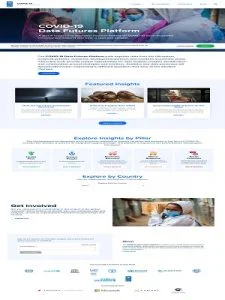
UNDP has supported governments in Guinea Bissau, Zimbabwe, Burundi, and Djibouti to integrate COVID-19 trackers into their existing national health information systems that use the electronic district health information system 2 (DHIS2) software. Having previously worked with Oslo University to help numerous countries roll out DHIS2 to enhance routine health information, during the pandemic, UNDP provided technical assistance to help ministries of health adapt and install the DHIS2 COVID-19 module. This digital data package supports surveillance workflows and automated analysis for key components of routine and active surveillance including:
Key Resources