UNDP’s approach to sustainable procurement for health products
In close collaboration with governments, United Nations agencies, international organizations, manufacturers, freight forwarders and partners, UNDP is adopting incremental measures and models in its health procurement practices to minimize environmental impact and to incorporate economic and social sustainability. Key partnerships and priority programme areas are outlined below.
UNDP sustainable procurement in the health sector programme
UNDP hosts the secretariat and participates in the United Nations Informal Interagency Task Team on Sustainable Procurement in the Health Sector (SPHS). The taskforce brings together seven United Nations agencies (UNDP, United Nations Environment Programme – UNEP, United Nations Children’s Fund – UNICEF, United Nations Population Fund – UNFPA, United Nations High Commissioner for Refugees – UNHCR, United Nations Office for Project Services – UNOPS, World Health Organization – WHO) and three multilateral health financing institutions (Gavi, the Vaccine Alliance – Gavi, Global Fund to Fight AIDS, Tuberculosis and Malaria – Global Fund, Unitaid). The annual cumulative purchasing power of the taskforce for health products is around $5 billion, which gives opportunities to influence and pilot business models for improving environmental, social and economic sustainability. With increased health spending during the pandemic, this figure has risen two-fold in the last 2 years.
UNDP’s Sustainable Health Procurement programme strives to promote sustainable production and consumption practices by ensuring products and services purchased have the lowest environmental impact and contribute towards positive social results. The UNDP approach to sustainable health procurement also leads towards considerable cost benefits and resource efficiencies in health procurement.

Additionally, UNDP worked with Healthcare Without Harm to develop and launch the chemicals of concern to health and environment guidance document. This document includes a list of chemicals of concern to human health and the environment. The list is based on systematic evidence reviews from authoritative sources, which identify chemical and material hazards of concern that are carcinogenic, mutagenic, endocrine disrupting and reproductive hazards (health hazards) and bio- accumulative and persistent to the environment and/or listed in International Environmental instruments (Conventions)
Pharmaceutical packaging optimization
Rethinking the necessities of packaging helps to reduce waste, optimize shipments and save costs which can be reinvested in health activities and in strengthening national supply chains.
UNDP is engaged in packaging optimization of health products and further investigating areas for innovation of product waste management. The packaging reduction project is conducted in partnership with manufacturers and freight forwarders to identify areas of opportunity, redesign packaging specifications and to calculate metrics to measure the impacts through capacity enhancement, reduced emissions and cost savings achieved.
CO2 emissions reporting and reduction
Monitoring, measuring, reporting health product transport’s CO2 footprints and rethinking procurement planning and transport help reduce environmental impact and gain cost efficiencies.
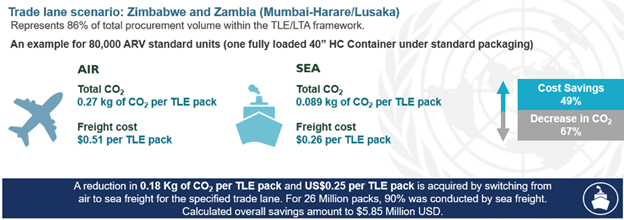
UNDP is committed to reducing its CO2 footprint, including the CO2 footprint of health procurement to reduce the impact of climate change. Since 2015, UNDP has been collecting CO2 data as part of long-term agreements with specified antiretrovirals first line suppliers to measure, monitor and reduce CO2 impacts in partnership with freight forwarders. All collected data is captured as business intelligence analytics and visualized through a dashboard that is monitored on a quarterly basis. The UNDP procurement planning capacity engagement and data provided by UNDP country offices is also used to switch to more efficient freight options that provide reduced emissions per shipment, resulting in significant CO2 reductions and freight cost savings.
Environmental and social sustainability scorecard initiative and call-off criteria for tendering
Leveraging its global health procurement architecture, UNDP’s environmental and social sustainability initiative incrementally builds a dialogue and a demand for sustainable pharmaceutical production and procurement.
UNDP is committed to working in partnership with manufacturers to meet demand for better social and environmental due diligence in pharmaceutical manufacturing and procurement. The UNDP environmental and social sustainability scorecard initiative leverages the UNDP health procurement architecture within its signed long-term agreements and contract management process. By strategically selecting health products of high volumes, this approach encourages manufacturers to follow sustainability manufacturing criteria under the UNDP Sustainable Health Procurement Programme, as part of the ongoing procurement contracts.
Sustainable Health in Procurement Project (SHiPP)
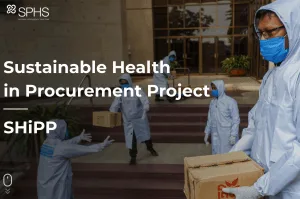
UNDP together with Health Care Without Harm (HCWH) implemented the Sustainable Health in Procurement Project (SHiPP). The first phase of the project addressed the intersection between health, human rights and the environment in 10 countries (Argentina, Brazil, China, India, Moldova, South Africa, Tanzania, Ukraine, Vietnam and Zambia). SHiPP was designed to promote procurement practices that consider environmental and social impacts, as well as cost-efficiency and affordability when defining how processes can be sustainable, and to mainstream gender and human rights including anti-corruption, transparency and accountability.
Impact Stories that Inspire
SHiPP amplifies the voices of incredible and extraordinary women and men passionate about introducing health sector practices that improve their working conditions, the lives of their communities and help protect the environment.
Nearly 60 million health workers worldwide deliver care and services to patients either directly as doctors and nurses or indirectly as aides, helpers, laboratory technicians and medical waste handlers. These individuals are our most valuable resource for health, and many of them are now leading the way to a more sustainable future by taking care of people in their communities and the environment.
Key Resources
Health Care Without Harm This is the second in a series of research and policy papers that Health Care Without Harm and Arup have produced together to identify a set...

Global Forum, , Health Care Without Harm, United Nations Development Programme
United Nations Development Programme, Green Procurement Index Health UNDP has developed a guide for procurement practitioners to monitor and evaluate compliance with international conventions for environmental safeguarding.
United Nations Development Programme, Health Care Without Harm, Green Procurement Index HealthAs part of the engagement on sustainable health procurement, UNDP has developed a questionnaire on environmental practices of suppliers....