UNDP's commitment to addressing HIV and other major health and development challenges is based on the principles that health is a driver for and an indicator and outcome of development.
As outlined in the UNDP Strategic Plan 2022-2025, UNDP’s support to countries aims to eradicate poverty in all its forms and dimensions, accelerating structural transformation for sustainable development and supporting governments to build resilience to shocks and crises.
UNDP defines capacity development as the process through which individuals, organizations and societies obtain, strengthen and maintain the capabilities to set and achieve their own development objectives over time.
Strong partnerships are the cornerstone of UNDP's work to strengthen systems for health. In its support to countries UNDP works closely with other United Nations entities, development organizations, civil society organizations, the private sector, academia and key populations to develop resilient and sustainable systems for health.
The effectiveness of UNDP's model of health programme support, with its emphasis on end-to-end capacity development, is evident in the results of its long-standing partnership with the Global Fund to Fight AIDS, Tuberculosis and Malaria (the Global Fund).
Whether in its role as an implementing partner managing large-scale HIV, TB, and malaria programmes funded by the Global Fund or as a technical assistance
Investments in resilient and sustainable systems for health lay the foundation for the effective and equitable delivery of HIV, tuberculosis (TB) and malaria.
Human rights barriers include stigma and discrimination, punitive laws, policies and practices, violence, harassment, gender, and social and economic inequalities.
People most affected by HIV, tuberculosis (TB) and malaria are often the same people who are marginalised and have limited or no access to health care.
Gender equality is essential to achieving health and well-being for all, accelerate progress towards the health-related Sustainable Development Goal (SDG) targets and ensuring that no one is left behind.
Monitoring and routine controls reduce the risk of losses through fraud and suboptimal decision-making. The controls also create an environment which discourages corruption and enables instances of fraud and the to be detected.
Routine controls are the detailed internal controls that are embedded within the operations of the organization. They consist of prevention and detection/monitoring controls. Prevention controls restrict an unintended activity from occurring. Detection controls aim to identify activities that have occurred but were not planned.
Controls can also be considered as organizational, physical and personnel based. Organization controls set the structure of the entity and ensure the adequate segregation of duties to minimize fraud and collusion. Physical controls ensure the safeguarding of assets, the authorization and approval of transactions and the presence of accounting controls. Personnel controls include ensuring the recruitment of suitably qualified personal, adequate supervision and management oversight.
UNDP’s approach
UNDP has assisted health programmes, including those funded by the Global Fund to Fight AIDS, Tuberculosis and Malaria (Global Fund), to improve monitoring and routine controls. This includes by:
sensitizing health personnel on the importance of monitoring and routine controls to reduce the risk of losses through fraud and bad decision-making
developing specific tools, methodologies and good practices in response to high corruption risks within the health sector (refer to the section on anti-corruption for health to learn more about UNDP’s approach to corruption prevention).
working with ministries of health to improve existing national systems and procedures with robust systems of monitoring and routine controls within health programmes
where weak controls are identified, working with national partners to develop an action plan and propose interim alternative arrangements, alongside the implementation of measures to support the long-term goal of strengthening overall financial controls
providing technical support to civil society organizations and governments to 1) design and implement cost-effective monitoring and controls systems ensuring compliance with national legislation as well as international best practice; and 2) develop manuals, guidelines and standard operating procedures to establish routine internal controls for inducting new staff and training existing staff members using a capacity-assessment tool to help identify areas for strengthening monitoring and internal controls within health systems
identifying capacity-development milestones and indicators, including training needs, to measure improvements in the internal control environment facilitating training sessions and workshops for finance and non-finance staff working within health programmes, including on donor requirements, systems and routine controls.
Guidance
Typical controls for financial management should include:
Controls over cash and bank
dedicated bank accounts (or sub-activities) where appropriate
physical controls over petty cash, including restricting the amount of petty cash held
at least two signatories required for payments
preparation of monthly bank reconciliations
review of bank reconciliations
regular petty cash counts
Controls over fixed assets
system for identifying fixed asset needs
systems to ensure physical security of assets
procedures to monitor use of assets, particular vehicles and computers and highly sensitive diagnostic equipment
insurance of assets in case of theft or damage
maintenance of fixed assets register
procedures for asset acquisition, transfer and disposal
periodic asset verification and reconciliation to fixed assets register
Segregation of duties
Segregation of duties should ensure that no single individual has sole responsibility for any single transaction from authorisation to completion and review.
While acknowledging that this may be challenging in small or rural settings, segregation of duties is an important tool for the deterrence and the detection of misuse of funds or assets.
Suggested capacity-development indicators
Suggested indicators to monitor improvements in monitoring and routine controls include:
Policies and procedures manuals are approved and available.
The policies and procedures are reviewed and updated every three to five years.
A certain percentage of staff confirm that they are aware of the whistle-blowing policy
The financial systems and procedures are reviewed by the external audits and assessed as good or satisfactory
A certain percentage of finance staff have been trained in standard operating procedures.
All bank accounts (including inactive accounts) are reconciled regularly and monthly bank reconciliations are available with evidence of review
A surprise petty cash count reveals no errors
Regular monitoring visits/spot checks are conducted
A certain percentage of fixed assets are insured
An inventory of fixed assets is available, and a physical verification has been undertaken in the last 12 months
New staff members are inducted within two weeks of arrival
The purpose of this toolkit is to provide guidance and checklists to facilitate the self-assessment of internal control systems and practices in the health sector.
This study presents tools and good practices to map corruption risks, develop strategies and sustain partnerships to address challenges and tackle corruption in the health sector.
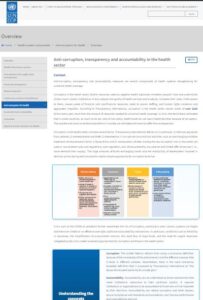
For additional resources on anti-corruption, transparency, and accountability in the health sector, visit the Anti-corruption for health page of the UNDP Health Implementation Guidance Manual.