Case studies: strengthening health information systems
Digitalizing the health management information system in Zimbabwe
Digital solutions that allow for real-time data collection and visibility have the potential to enhance all aspects of health information management and the functioning of the overall health system. In Zimbabwe, the digitalization process was prompted by the rapid growth in programmes for HIV and other epidemics in the early 2000s and the limited capacity of health workers to manually process large volumes of patient information. The transition away from paper-based reporting, and the genesis of the modern national health information and surveillance system, began in 2010 with the national roll-out of District Health Information System 1.4 (DHIS-1.4), an electronic platform for aggregate reporting of health data from the district level upwards.
Governance
- Policies and strategic documents were developed, including through UNDP’s support to the ICT policy (2018), national M&E Policy Guidelines and Strategy (2018), and the e-Health Policy (2018), which guide the roll-out of ICT innovations to accelerate progress towards universal health coverage. UNDP also supported the end-term evaluation of the 2010–2015 National Health Information Strategy (NHIS) and the development of the 2020–2025 NHIS, with ongoing work to identify a consultant.
- Assessments were conducted to guide investments in health information systems and capacities, including 1) a one-week data analysis for MoHCC in 2015, in collaboration with the Global Fund, the World Health Organization (WHO) and the University of Oslo, to assess the quality of data generated by the health information system and train health information officers at all levels for increased data analysis and usage; and 2) comprehensive assessments in May–June 2018 to inform national roadmaps for the implementation of new systems and enhancements to the existing ICT infrastructure.
- Three-year plans (2014–2016 and 2017–2019) were finalized to guide the direction of the national health information department in the implementation of identified priorities.
- National coordination bodies were strengthened through financial and technical support from partners, including the establishment of working groups to coordinate the development of new information systems and reduce fragmentation across systems.
Systems and infrastructure
- DHIS-2 was rolled out in all health facilities as a web-based national system to collect, extract and disseminate aggregated district-level health data for weekly and monthly reporting.
- ePMS was installed at more than 620 sites, enabling the collection of patient-level data for HIV and other services, with the development of a macro database allowing for data synchronization across all ePMS sites and analysis at the central level.
- Weekly disease surveillance was enhanced through the introduction of FrontlineSMS, a mobile phone-enabled tool to collect and transmit surveillance data in real-time to districts and centrally for rapid response.
- Major developments were undertaken towards a unified national health information system, with 13 systems integrated into DHIS-2, including ePMS and the Weekly Disease Surveillance System.
- ICT infrastructure and connectivity were improved countrywide for the effective functioning of electronic data systems and central storage of databases, including the development of a state-of-the-art data centre and server in MoHCC, provision of laptops at all levels, payment of internet and phone subscriptions, and installation of solar energy at health facilities through the Solar for Health initiative.
Human resources
- Coherent strategies for ICT-skills building were operationalized, including through support to develop a comprehensive ICT capacity development plan (2017–2018).
- Over 6,000 health-care practitioners, data clerks and policymakers were trained in various health management information systems at the facility, district, provincial and central levels, contributing to improvements in basic data literacy as well as the accuracy and completeness of reporting.
- Sustainability on the implementation and use of data systems was enhanced through capacity-building and skills transfer activities provided through UNDP-managed projects.
More information on UNDP’s multifaceted support to the health management information systems in Zimbabwe can be found in the UNDP Brief: UNDP and Global Fund Support to Strengthen the National Health Management Information System
UNDP Djibouti: the use of new technologies for data collection and management
UNDP has amassed a wealth of experience in providing technical assistance to national entities supporting national capacities for monitoring and leveraging emerging data sources for real-time monitoring in countries where UNDP is an interim Principal Recipient of grants from the Global Fund to Fight AIDS, Tuberculosis and Malaria (The Global Fund).
In Djibouti, UNDP supported the Ministry of Health (MoH) to introduce a mobile data collection and management tool in 2020 to address data collection and activity monitoring challenges faced under the Global Fund to Fight AIDS, Tuberculosis and Malaria (The Global Fund) malaria programme. Specifically, within the context of Djibouti’s indoor residual spray campaign and adjustments made amid the COVID-19 pandemic, the programme faced challenges linked to delayed data availability, manual transcription errors and data duplication across activities. These issues meant a lack of complete and reliable data to guide decision-making and ensure quality control.
UNDP sought out technological solutions that could help to resolve some of these gaps. Among the solutions identified was the KoBo Toolbox and UNDP supported MoH to adopt this free, open-source suite of tools for data collection and analysis, and specifically designed for use in challenging environments. Through the KoBo Collect application, the tool offers a series of features to facilitate the data manipulation process from collection to analysis and visualization. Health authorities download the application to mobile phones or tablets to collect data from the field and upload it to a server for analysis. UNDP helped to train teams in charge of data collection on how to use the form, and conducted a pre-test exercise and debriefing. The graphic below outlines the implementation process used to launch the Kobo system for tracking indoor residual spray under the MoH 2020 malaria campaign.
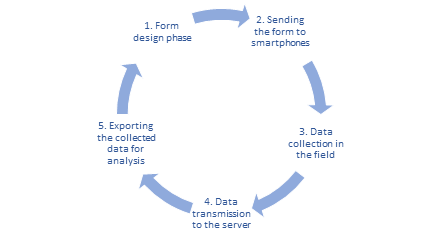
The KoBo Toolbox has allowed MoH and UNDP to proactively monitor indoor residual spray activities through online applications that produce timely data, to troubleshoot implementation challenges and to inform or share decision-making with communities, without physically being present at the project sites. The real-time monitoring has improved the exchange and sharing of data by health authorities, supporting more regular problem identification, analysis and responses. The system also offers an online analytics module for conducting basic data analysis, which has helped to motivate staff to reach set targets.
Presentation (French): UNDP Djibouti, Jan 2021: Mobile Data Collection and Management Using KoBo Toolbox